

Friday, September 5, 2008
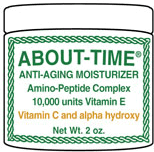
Baby boomers and others who once sought the sun's rays with little thought of skin damage are now paying the price billions of dollars annually for cosmetics containing alpha hydroxy acids (AHAs). Derived from fruit and milk sugars and served up in creams and lotions, AHAs attract customers with their supposed ability to reduce wrinkles, spots, and other signs of aging, sun-damaged skin. Some scientific evidence suggests they may work.
But are these products safe? Since 1989, the Food and Drug Administration has received more than 100 reports of adverse reactions in people using AHA products. Their complaints included severe redness, swelling (especially in the area of the eyes), burning, blistering, bleeding, rash, itching, and skin discoloration.
FDA believes reactions from AHAs are probably even more widespread. Past experience suggests that for every adverse reaction report the agency receives, the manufacturer receives 50 to 100. "This would translate into approximately 10,000 adverse reactions being received for AHA-containing products," says John Bailey, Ph.D., acting director of FDA's Office of Cosmetics and Colors.
Also, their relative newness (they have been widely available only since about 1992) means that their long-term effects are unknown. An industry-sponsored study found that people who use AHA products have greater sensitivity to sun, raising the specter of greater risk of photoaging and skin cancer.
"There are many unanswered questions in front of us," Bailey says. "AHAs are unlike anything else ever introduced onto the cosmetic market on such a wide scale. They are not your traditional cosmetics."
In spring 1997, the National Toxicology Program of the National Institute of Environmental Science accepted FDA's proposal to study AHA safety. While FDA awaits the results, expected by the year 2000, the agency is cautioning consumers to take extra care with AHA products: for example, avoiding the sun when possible, otherwise using adequate sun protection, and reporting adverse reactions immediately to doctors or FDA directly.
"These are very, very popular products," Bailey says. "Very little about the process restricts their sale. And it's a somewhat alarming idea to put acids on the skin. It raises obvious safety questions."
For more information : http://www.foodsafety.gov/~dms/fdacaha.html
But are these products safe? Since 1989, the Food and Drug Administration has received more than 100 reports of adverse reactions in people using AHA products. Their complaints included severe redness, swelling (especially in the area of the eyes), burning, blistering, bleeding, rash, itching, and skin discoloration.
FDA believes reactions from AHAs are probably even more widespread. Past experience suggests that for every adverse reaction report the agency receives, the manufacturer receives 50 to 100. "This would translate into approximately 10,000 adverse reactions being received for AHA-containing products," says John Bailey, Ph.D., acting director of FDA's Office of Cosmetics and Colors.
Also, their relative newness (they have been widely available only since about 1992) means that their long-term effects are unknown. An industry-sponsored study found that people who use AHA products have greater sensitivity to sun, raising the specter of greater risk of photoaging and skin cancer.
"There are many unanswered questions in front of us," Bailey says. "AHAs are unlike anything else ever introduced onto the cosmetic market on such a wide scale. They are not your traditional cosmetics."
In spring 1997, the National Toxicology Program of the National Institute of Environmental Science accepted FDA's proposal to study AHA safety. While FDA awaits the results, expected by the year 2000, the agency is cautioning consumers to take extra care with AHA products: for example, avoiding the sun when possible, otherwise using adequate sun protection, and reporting adverse reactions immediately to doctors or FDA directly.
"These are very, very popular products," Bailey says. "Very little about the process restricts their sale. And it's a somewhat alarming idea to put acids on the skin. It raises obvious safety questions."
For more information : http://www.foodsafety.gov/~dms/fdacaha.html
posted by Antiagingmax
@ 10:39 PM
permanent link | Post a Comment
|


0 Comments:
Post a Comment
<< Anti aging cream home